
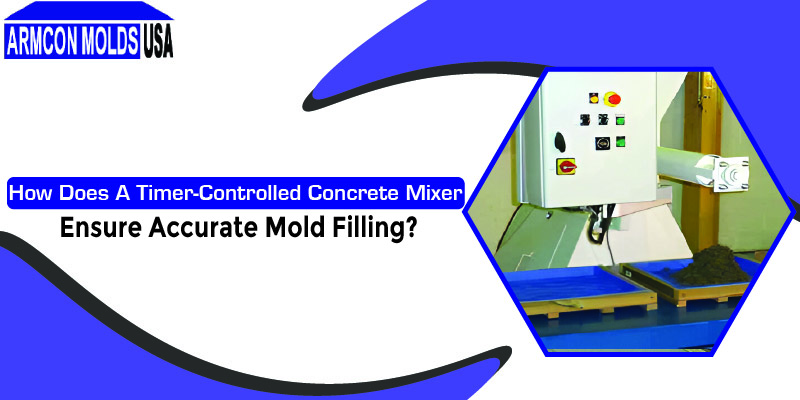
If you’ve spent any real time filling precast molds, you know the truth: manual pouring is never perfectly consistent. One mold ends up a little short, the next one overflows, and suddenly you’re wasting concrete and slowing everyone down. In 2026, most precast shops don’t have the patience, or the margins, for that anymore.
That’s why timer-controlled concrete mixers have become so common. They take the “eyeballing it” out of mold filling and replace it with something far more reliable: repeatable, controlled delivery.
Once the timer is set, the mixer releases concrete for the same amount of time, every single cycle. Same flow, same volume, same result.
Why Timer Control Makes Life Easier on the Floor?
The real value of timer control isn’t just accuracy—it’s peace of mind. When concrete flows at a steady rate and the discharge time is fixed, mold filling becomes predictable.
What that looks like day to day:
- Molds hit the right level without constant checking
- Edges come out cleaner with less overflow
- Less concrete ends up on the floor or in the scrap pile
- Products cure more evenly because volumes are consistent
Most modern systems also use vibration to keep the concrete moving smoothly. That’s especially helpful now, since many precast mixes are stiffer than they used to be. Instead of stopping to poke or shake the mold, the system keeps things flowing on its own.
After a short setup period, operators stop thinking about each individual pour. The process just runs.
Also read- How Concrete Vibrating Tables Make Mold Casting Easier
Does a Concrete Mixer Replace a Traditional Batching Plant?
This is one of those questions where the answer depends on what you’re actually making.
Batching plants are great if you’re producing huge volumes of concrete all day long. They’re built for scale, not precision mold work. For many precast producers, that’s more than they really need.
A timer-controlled concrete mixer works better for precast because:
- It doesn’t take up half your yard
- It’s easier to run and easier to fix
- It’s focused on mold filling, not bulk volume
- It costs less to own and maintain
In 2026, plenty of precast yards run entirely on automatic mixers without a full batching plant. Bigger operations might still use both, but for everyday mold production, the mixer is doing most of the heavy lifting.
How Much Faster Does an Automatic Mixer Actually Make You
Manual mold filling is slow, even when people are good at it. It’s also tiring, and tired people make mistakes.
Once a timer-controlled mixer is in place, most shops notice changes almost immediately:
- Molds fill faster, one after another
- Operators aren’t stopping to fix overfills or low spots
- Cleanup time drops
- Rejected pieces become rare
It’s common to see production speeds improve by 30 to 50 percent just by automating mold filling. Some shops manage to squeeze in another production cycle per shift without adding workers.
In today’s market, that extra output can be the difference between keeping up with demand and falling behind.
What Actually Matters When Choosing a High-Accuracy Mixer
Spec sheets are one thing. Real-world use is another.
If you’re choosing a concrete mixer for precast work, here’s what really matters:
- Timer controls that are simple and reliable
- A smooth, steady discharge, not surging or stopping
- Built-in vibration so concrete doesn’t hang up
- Solid construction that can handle daily use
- Controls operators can understand without weeks of training
In 2026, flexibility is also huge. Most precast shops want equipment that can handle different molds and grow with production, not something they’ll outgrow in a year.
Where to Buy a Reliable Concrete Mixer in the USA
This part gets overlooked a lot, but it matters. Buying from someone who understands precast production saves a lot of frustration later.
General construction mixers aren’t always built for mold accuracy. Precast-focused suppliers design equipment specifically for repeatability, consistency, and long production runs. That difference shows up fast once the machine is on your floor.
The bottom line
Timer-controlled concrete mixers aren’t about automation anymore. In 2026, they’re about working smarter and keeping production sane. They help precast producers fill molds accurately, move faster, and waste less material without babysitting every pour. They won’t replace every batching plant, but for most precast operations, they’re one of the most practical upgrades you can make.
If you’re ready to make mold filling simpler and more consistent, buy a timer-controlled concrete mixer on sale at Armcon Molds USA.
FAQs
- What is a timer-controlled concrete mixer and how does it work?
- Can a single timer-controlled mixer handle different sizes of precast molds?
- Is using an automatic concrete mixer worth it for a small precast shop?
It’s a mixer that fills precast molds with the same amount of concrete every time. You set the timer, and it does the rest.
Yes. You just adjust the timer for each mold, so one mixer can work for many products.
Absolutely. It saves time, reduces mistakes, and keeps every mold consistent.